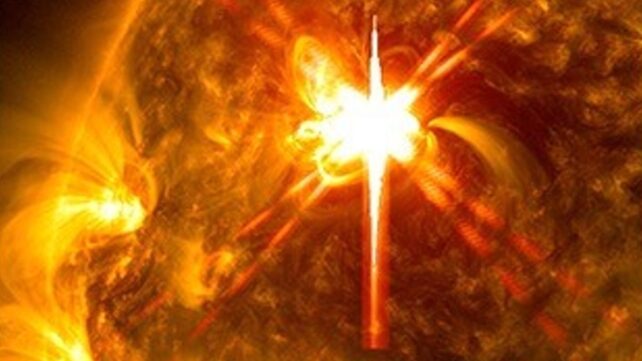
The Sun has unleashed a quartet of strong solar flares, which could herald a wild week of space weather.
It all kicked off at 12:33 UTC on February 1, when the Sun fired off an X1.0 flare.
About 11 hours later, at 23:37 UTC, a massive eruption occurred with an X8.1 flare. Two more followed on February 2, with an X2.8 flare at 00:36 UTC and an X1.6 flare at 08:14 UTC.
X-class flares are the strongest the Sun can produce. In fact, the X8.1 event was the most powerful since October 2024, and the 19th-strongest on record.
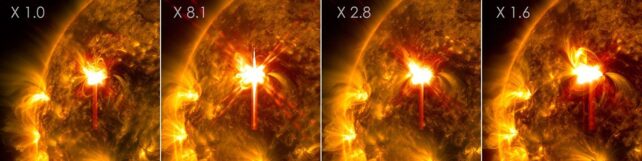
These flares erupted from a cluster of sunspots designated RGN 4366, which has only just started its Earth-facing journey, according to NOAA's Space Weather Prediction Center.
"If this spot group continues to evolve, remains complex, and erupts with any powerful solar flares, there could be increased chances of energetic particle events and possible even coronal mass ejections (CMEs) to watch for," the Space Weather Prediction Center says.
Related: The Most Violent Solar Storm Ever Detected Hit Earth in 12350 BCE
CMEs are big blasts of plasma ejected from the Sun, which are often associated with the best and worst effects of solar storms. They can produce the stunning light shows we experience as auroras – but can also disrupt satellites, power grids, and communications tech.

If it feels like strong solar activity has been in the news more than usual lately, there's a reason for that.
Our Sun has recently passed the most active phase of its 11-year cycle, which gave us some incredible light shows in 2024.

Although it's expected that solar activity should be winding down between now and the start of the next cycle, in around 2030, it seems we might still be in for some wild space weather yet.
"Forecasters expect more exciting activity," the Space Weather Prediction Center says.
